The End of the Bottle: A Sensible UK Approach to Expired CBD and Its Packaging

Photo: Richard Webb , CC BY-SA 2.0, via Wikimedia Commons
The drawer of good intentions
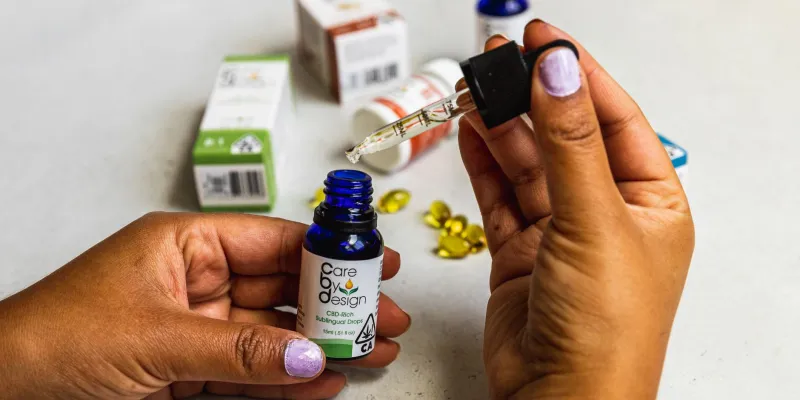
Somewhere in most UK homes that have tried CBD there is a drawer. In it live a bottle with perhaps eight millilitres remaining, a tub of capsules opened last spring, a gummy pouch containing three sweets and a lot of empty space, and the cardboard carton for a product that was discontinued two reformulations ago.
None of this is unusual, and none of it is malicious. CBD is bought in small quantities, used inconsistently, and rarely finished. The awkwardness of the last few millilitres — too little to feel like a proper dose, too much to tip away without a pang — produces exactly the paralysis that fills the drawer. This guide is about resolving that paralysis tidily.
Reading the date, and the batch
Before anything else, establish what you are actually holding. Best-before and expiry information on UK CBD products is usually printed on the base of the bottle, on the neck, or on the carton. Batch numbers, where present, sit alongside. If the carton has gone, the bottle may still carry both.
Two distinctions matter. A best-before date is a quality marker: the manufacturer's assessment of how long the product will remain within specification. An expiry date, where one is stated, is a firmer statement. Neither is a switch that flips at midnight. What changes over time is predictability: cannabinoid content may decline, carrier oils can turn, flavour can shift, and the label's stated milligrams per millilitre becomes progressively less reliable as a description of what is in the bottle.
That last point is the practical reason to care. A product two years past its date is not necessarily dangerous, but it is no longer a known quantity, and the whole purpose of buying a labelled CBD product is to know the quantity.
What a past date does and does not mean
It is worth resisting both extremes. Treating an out-of-date bottle as radioactive is unnecessary. Treating it as fine because 'it's only oil' is equally careless, particularly where the product has been stored somewhere warm, exposed to light, or left with the cap loose.
A reasonable rule is this: once a product is past its stated date, or has been open for substantially longer than the manufacturer's guidance, stop using it and stop planning to use it. The decision has been made; the remaining question is administrative rather than pharmacological.
Three things not to do
Do not flush it. CBD oils are typically suspended in carrier oils such as MCT or hemp seed oil, and pouring them down the sink or toilet introduces fats into household drainage and, ultimately, into watercourses that are not designed for them. The same applies to capsules tipped into the loo.
Do not put loose product in the kerbside bin. A full bottle in a general waste bag will leak into the rest of the bag, and a gummy pouch emptied into the bin sends food waste and cannabinoids into a waste stream with no take-back provision.
Do not hand it on. Passing an opened, out-of-date CBD product to a friend or relative transfers an unknown quantity to someone who did not choose it and cannot verify it. It is not a favour.
Council routes, plainly
Disposal in the UK is a local matter, and arrangements genuinely differ between authorities, so the first step is the council's own waste pages rather than a general assumption.
In most areas, the household waste recycling centre — the tip — is the appropriate destination for products you cannot put in the bin, and staff can direct you to the right container for oils or liquids. Many councils also run or support local collection points for medicines, usually located in pharmacies; these schemes are designed primarily for prescription and over-the-counter medicines, so it is worth asking the pharmacy directly whether they will accept a CBD supplement rather than assuming they will.
Small quantities of liquid in a sealed container are usually accepted at a recycling centre, but the sealed part matters. Double-bagging a leaking bottle before transport is normal practice, not paranoia. If you are unsure, telephone the site before making the journey.
Packaging, item by item
Dropper bottles are the simplest case. Glass bottles are widely recycled at kerbside, provided they are empty and rinsed; the rubber teat and plastic collar usually are not, and should be separated if the design allows. Plastic dropper bottles are frequently LDPE or PET, and kerbside acceptance depends on your authority's list.
Pipettes are the recurring problem. A glass pipette with a rubber bulb is a mixed-material item and rarely recyclable at kerbside; it belongs in general waste unless your council says otherwise. Cardboard cartons and paper leaflets go with the paper recycling. Gummy pouches, foil-lidded trays and sachets are almost always composite materials and are best treated as general waste unless the brand operates a take-back scheme — and some now do, so check the brand's own site before assuming.
Before it goes: a thirty-second record
There is one small step worth taking before anything leaves the house. Photograph the label and the base of the bottle. If you later want to query a product, compare a batch, or simply remember which strength you used and did not get on with, that photograph is the only surviving record once the packaging is gone.
A routine that fits a bin day
CBD disposal does not need a dedicated occasion. Once or twice a year, empty the drawer, check dates, photograph anything you are discarding, and make one trip to the recycling centre with the items that cannot go kerbside. Replacing a vague intention with a routine is, in the end, the whole of the method.